The most beautiful thing in the world... is a shoe.
Or at least, that's what the opening number of Kinky Boots tells us, and I find it difficult to disagree after seeing some of the beautiful boots in the London production, currently on at the Adelphi Theatre.
Telling the story of a young man who takes on his late father's shoe factory, the drag queen he encounters, and the plan they come up with to save the factory by manufacturing a line of shoes for drag queens, Kinky Boots is fun, fabulous and feel-good, and I say that having seen it from the nosebleed seats at the Adelphi, so it must be glorious close up.
The show features Matt Henry as Lola and Killian Donnelly as Charlie. Henry's role is louder and more in your face, but he brings a depth to Lola that makes you connect with her on a number of levels and he's able to make her quieter moments just as addictive to watch as her louder numbers. Not My Father's Son and Hold Me In Your Heart are both beautiful ballads, full of heart, and Henry sings the heck out of them.
Showing posts with label Theatre. Show all posts
Sunday, 13 September 2015
Tuesday, 2 July 2013
Theatre review: Charlie and the Chocolate Factory at the Theatre Royal Drury Lane
![]() |
| Douglas Hodge as Willy Wonka in Charlie and the Chocolate Factory. Picture: Helen Maybanks |
So it was with great anticipation I went along to see Charlie and the Chocolate Factory at the Theatre Royal Drury Lane. The musical, building on the critical and commercial success of Tim Minchin's musical version of Matilda, has been directed by Oscar winner Sam Mendes, and tells the story of Charlie Bucket, who wins one of five golden tickets to visit Willy Wonka's chocolate factory.
And let me tell you, this version's not half bad.
You can tell a film director has put this together, because visually it's stunning. The sets are incredible, from the opening scene in a dank, polluted town, through Charlie's poky but loved home, via all the houses belonging to the other kids lucky enough to have won golden tickets, and right through to Willy Wonka's chocolate factory. The production uses a mix of physical sets and projections to create the world within.
Also stunning is the opening - the story of how the cacao bean becomes chocolate. It's voiced by Willy Wonka (Douglas Hodge) and shown on a projection, with the story illustrated by Quentin Blake, who collaborated with Dahl to illustrate his many books. This beginning was for lovers of Dahl, and it made me feel at home.
The aforementioned Hodge is a delight as Willy Wonka, straddling the line between crazy, sincere and damaged with perfect precision. And Hodge's voice is wonderful to listen to, especially when he sings one of the show's final songs, Pure Imagination, which is from the Wilder film.
Hodge is easily the strongest of the actors on stage. While the other adults (Charlie's parents and grandparents, and the parents of the other kids touring the factory) round out the show, they're not really compelling enough or on stage long enough to become so. That's even the case with Charlie's grandfather, Grandpa Joe (Nigel Planer) who accompanies him to the factory.
![]() |
| Tom Klenerman as Charlie Bucket. Picture: Helen Maybanks |
The Oompa Loompas are interestingly done - played by adults using a combination of puppets and clever costumes, and while they're amusing, they're not that impressive.
Musically, the show is adequate. The only number I've remembered is Violet Beauregarde's theme tune - Double Bubble Duchess. Everything else was pretty forgettable, including the numbers by the Oompa Loompas, which were great while they lasted but which I can't for the life of me remember now.
Despite its faults, I left Charlie and the Chocolate Factory feeling pretty upbeat and with a huge smile on my face. It may not be perfect, but Charlie and the Chocolate Factory is a feel-good show, powerful enough to beat any high a bar of chocolate may give you.
Wednesday, 6 February 2013
Theatre review: Old Times at the Harold Pinter Theatre
![]() |
| Kristin Scott Thomas as Anna, Lia Williams as Kate and Rufus Sewell as Deeley in Old Times. Picture: Simon Annand |
And that's the relationship explored in Harold Pinter's play Old Times, starring Kristin Scott Thomas, Lia Williams and Rufus Sewell and currently playing at the Harold Pinter Theatre.
Scott Thomas and Williams alternate the roles of Kate and Anna, and the production I saw had Scott Thomas as Anna and Williams as Kate.
Kate and her husband Deeley (Sewell) open the play discussing an old friend of Kate's who is coming to visit - a friend Kate hasn't seen in 20 years. The dynamic between the couple is fun and teasing, although there is an undercurrent of something that hides in Kate's face as Deeley questions her about her relationship with Anna (her "only friend").
Then in comes Anna - dynamic, full of laughter and memories about the pair's time together as secretaries in London, getting up for work after glamourous nights out, weekends filled with going to this show and that coffee bar and to see this film.
![]() |
| Williams as Kate and Sewell as Deeley. Picture: Simon Annand |
Meanwhile Kate sits and listens, looking increasingly uncomfortable as it becomes obvious that her relationship with Anna was something deeper than friends. At one point Kate accuses Anna of talking about her as if she was dead - an apt observation since for a large part of the play Kate, while being the subject of discussion and the point which Anna and Deeley flit around on stage, is actually a character who seems to do nothing much but react, and even then in an awkward, bland way.
Scott Thomas is compelling as Anna. Her every action, even when the focus is on others, belies that there is more to her relationship with Kate than Deeley knows - particularly poignant is a moment when Anna is clearly reaching for Kate's hand, only to be rejected and see Kate go to Deeley instead. And when she and Deeley are alone together, Scott Thomas reveals another side to Anna, a different Anna than the one she is with both Deeley and Kate, and with just Kate.
Sewell brings both tragedy and comedy to Deeley - a man with a successful career, a house in the country and a wife he seems to love. But as it is revealed that he knows less about her than Anna does, we stop laughing at his over-the-top gestures and booming voice, and start feeling sorry for him as we watch him break down - the last person to believe what he is seeing in front of his eyes.
![]() |
| Sewell as Deeley and Scott Thomas as Anna. Picture: Simon Annand |
Old Times makes for uncomfortable watching, but only because we feel for all the characters, and because we all have had some experience being the odd one out and wanting someone's approval over another person. Thought-provoking and beautifully nuanced, Pinter's play will leave you hooked on the mystery of what you've just seen.
Old Times is at the Harold Pinter Theatre, Panton Street, London, until April 6. Click here for more information.
Saturday, 23 June 2012
Review: Prometheus Awakes at GDIF
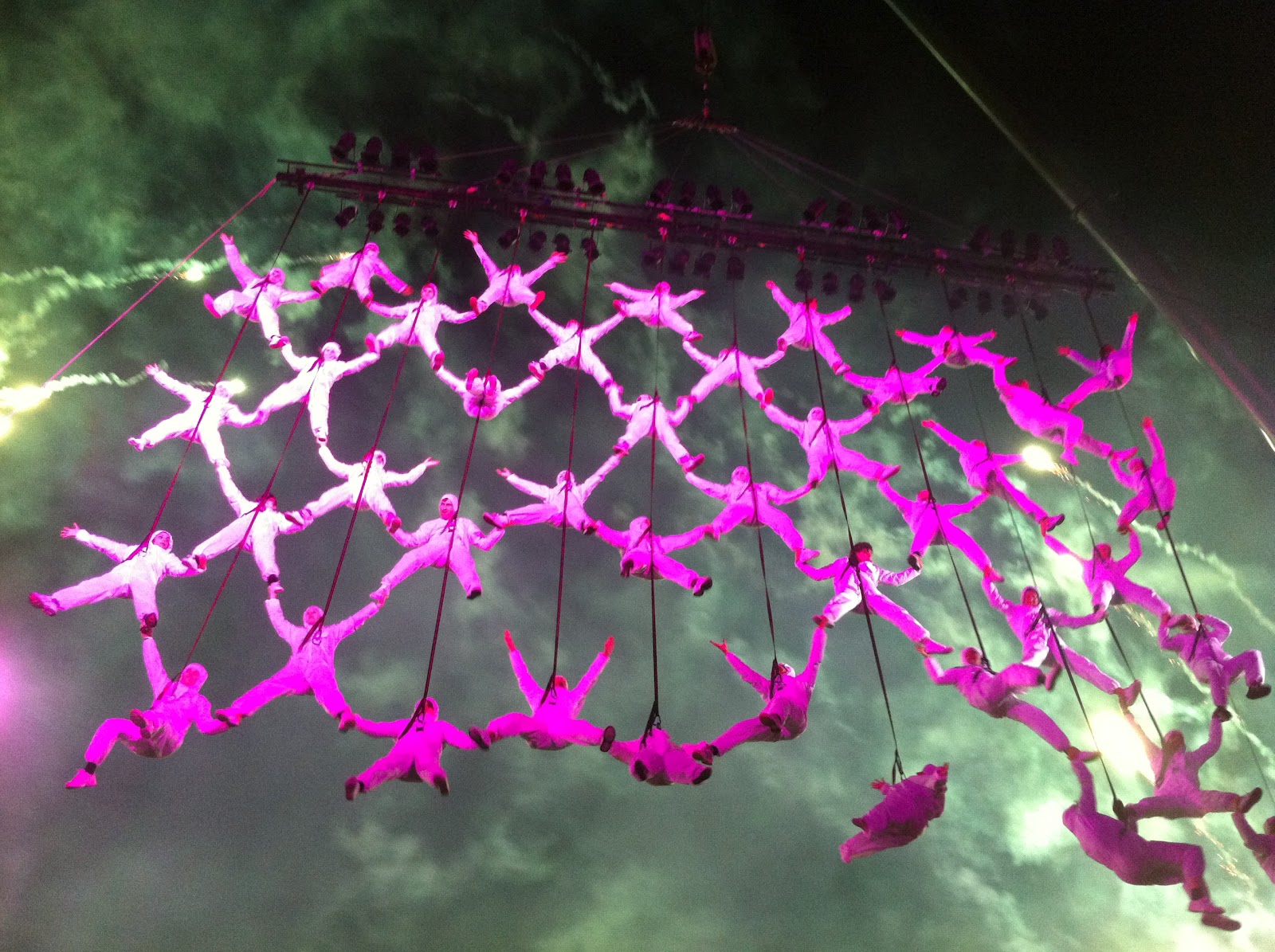
| The human net in Prometheus Awakes. |
Here's what I want to say (in a high pitched voice really fast): Oh my goodness, it was amazing, I loved it!
But I realise that I'm writing a review, so I should probably be a little less teenage girl, and expand a little more on my views.
The production was put together by disabled-led theatre company Graeae and Spanish company La Fura dels Baus, famous for their outdoor work and puppetry.
| Prometheus Awakes started with projections on the Queen's House. |
Prometheus Awakes melded the three myths of Prometheus - he created man, he invented fire, his liver was eaten by an eagle and then it regrew every day as a punishment from Zeus - seamlessly into one.
| Prometheus awakes. |
The production in the grounds of the Royal Museums Greenwich started with a boom and projections on the Queen's House, with the final ones showing the puppet Promethus and spelling out his name in both letters and in sign language.
In the audience our gaze then moved to the right, as the 25ft tall puppet of Promethus was slowly lifted from a lying position into a crane and then lit up. Six volunteers (and the crane) then steered Prometheus through the crowd.
While we were still busy gasping over this stunning spectacle Prometheus came to a stop, and our attention was once again diverted, this time to a bag being hoisted by a crane right over our heads. First glitter came out of the bag onto the crowd and then a woman appeared - the first human.
A trio of dancers on the balcony of Queen's House took our attention, and the first human soon joined them. As Prometheus made his was towards her - going around the back of the crowd - it was time for the fire. Flames leapt up into air before volunteer performers carrying flares walked purposefully through the crowd.
| The human censer. |
This was all stunning enough, with more projections of the Queen's House of fire and eagles adding to the thrill thrumming through the crowd. Then it was time for another of Graeae's set pieces - the human censer, which rose high above the crowd with performers on it doing daring dancing moves.
Prometheus Awakes also featured a giant hamster wheel of sorts, which rolled back and forth between the crowd, with the performers inside wowing everyone, and then all bursting into a shrill type of shrieking as the tale of Prometheus reached its dark point - Prometheus, in love with the first human, thought he was being rejected by her (I think) and she left the stage.
Moments later she reappeared, climbing up the body of Prometheus to rest at his shoulder and watch the play's stunning finale - a net of humans raised into the air to swing over the crowd to thumping music.
The cheers and clapping as the performers that made up the net danced only grew louder and louder, and the looks of joy on their faces as they took in the reaction of the crowd only fueled more applause.
Prometheus Awakes was a stunning production. It was truly interactive outdoor theatre, with an audience made up of everyone from young children to teenage friends to couples and families and more.
There was no need for barriers and stewards, as the audience moved seamlessly with the performers, knowing instinctively when to move out of the way and where to look - and we almost became a part of the production ourselves.
Graeae and La Fura dels Baus should be applauded for the work they did, as should all the performers, disabled and non-disabled. When I spoke to the play's co-director Amit Sharma, he said he wanted people to leave Prometheus Awakes thinking it was a great production and not thinking about how good it was in relation to it being disabled-led. He has succeeded. I didn't give a thought to whether the performers in front of me were disabled or non-disabled, for me Prometheus Awakes was just a hugely successful, hugely thrilling piece of outdoor theatre which I'm still thinking about hours later.
Prometheus Awakes will be performed once more at the Stockton International Riverside Festival on Thursday, August 2 at 10pm. Click here for more information.
Tuesday, 5 June 2012
Theatre review: Antigone at the National Theatre, starring Christopher Eccleston
![]() | |||
| Creon (Eccleston) and Antigone (Jodie Whittaker). Picture: Johan Persson |
Welcome to Antigone, showing at the National Theatre. Sure, this is a modern retelling of sorts, but that doesn't mean any of the death and blood are lessened.
Antigone tells the story of the titular character, who disobeys her uncle Creon's law and buries her brother. In return Creon sentences her to death, and although any number of people tell him to back down - including the blind prophet Teiresias - he refuses to do so.
The
play belongs to Christopher Eccleston as Creon, who we see turn from an
honourable leader (of sorts) to a tyrant to a broken man (covered in blood) in the space of 90
minutes.
The play
opens with a stunning reference to one of the most famous political photographs of the last few years, as the characters recreate the image of
President Obama and Hillary Clinton watching the capture and killing of
Osama Bin Laden.
And
the opening signifies the tune of the rest of the play. Yes, this is
Sophocles' Antigone, but Don Taylor wants to make it clear in his
version that all the things Sophocles wrote about thousands of years ago
are still relevant today, and the play is used as a comment on modern
society.
So
there are plenty of references to terrorism, and a clear argument about
who in the play is a terrorist. Is it Antigone, who disobeys the laws
of the land? Or is it Creon, the leader who abuses his power and can't
see the woods for the trees?
And
there is also much made of the role of women in society. Creon
underestimates Antigone, dismissing her as a woman who would not be
brave enough to disobey his word, only believing she has committed a
crime when the evidence becomes too much. Ismene, Antigone's sister,
while not directly taking part in the act, stands up to her uncle,
surprising him.
And after years of being useful only for bearing children, sending sandwiches for lunch and making sure Creon's tie is straight and his suit jacket unrumpled, Creon's wife Eurydice proves that her role as mother is perhaps more important than any other relationship in the play. It is only when she kills herself out of grief that Creon realises the women in his life should have been more valued, and he shouldn't have underestimated them.
The women actors are all strong, even as their characters sometimes wither under the command of the men.
Also good is Luke Newberry as Haemon, Creon and Eurydice's son, who commits suicide after finding Antigone has hanged herself in the cave where she was banished to die by Creon. Although Haemon initially comes across as a bit of a drip, he grows stronger in a scene where he tells his father how the people feel about Antigone's sentence.
In one of the few, if not only, comic interludes in the play, Haemon proceeds to disguise his own thoughts as those of others, providing an interesting back and forth between him and Creon. And while the exchange is humourous, it masks a very, very serious opinion - that everyone thinks Creon is wrong to sentence Antigone to death just for caring about her brother.
It's a play partially about power, and how it changes people. It clearly changes Creon, and it changes those around him, who are too afraid to stand up for what is right in the face of his power, at least not until it's too late.
![]() |
| Creon (Eccleston) with members of the company. Picture: Johan Persson |
Movement and music are used to great effect throughout. There are a number of scenes during which all the characters move at the same time, and then stop at the same moments. It's the little touches that are really noticeable - two characters lifting cups of coffee at the same time, the placing of chairs after each movement. This isn't just acting, it's also dance.
There were so many little things going on, at times I didn't know where I wanted to look the most. You could watch this play a dozen times, and still notice a dozen different things each time. Perhaps I should go and see it again...
To book tickets for Antigone at the National Theatre, click here.
Saturday, 26 May 2012
Theatre review: What the Butler Saw starring Omid Djalili, Tim McInnerney and Samantha Bond
![]() |
| Omid Djalili and Tim McInnerny in What the Butler Saw. Picture: Simon Annand |
Laugh-out-loud funny and completely outrageous, What
The Butler Saw isn’t for sensitive souls or the easily offended.
The play, currently on a limited run at the Vaudeville
Theatre, deals with gender politics, identity, sexuality, mental health and, as
it features a star turn by Winston Churchill, politics.
What the Butler Saw was the final play written by Joe
Orton, completed in July 1967. It's impossible for me to talk about Orton without mentioning how he died - he was bludgeoned to death by his lover, who then proceeded to kill himself.
Set in a single day and in one room, What the Butler
Saw follows a series of characters whose actions impact on one another in ways
they never considered when the day started.
The play opens with psychiatrist Dr Prentice (Tim
McInnerney) interviewing a new secretary by asking her to take her clothes off -
and What the Butler Saw only gets stranger from there, especially as some of the characters get drunker and drunker, or drugged and more drugged.
There’s the adulterous Mrs Prentice (Samantha
Bond - how does she look so amazing?!), her lover and blackmailer Nicholas Beckett, the curious policeman
Sergant Match, and government inspector and psychiatrist Dr Rance (Omid
Djalili).
Djalili is very good, but very much the Djalili
you’re used to seeing on television. Moments of high drama are emphasised
by shouting, something which becomes ever more present the more manic the
action on stage gets. Luckily for the actor the character of Dr Rance is
exactly that - shouty and manic, and Djalili really works in the role.
What the Butler Saw focuses on some issues too taboo
for everyday conversation, but does so by coating them in a layer of clever
jokes and staging.
It’s not an exaggeration to say some parts of the
play are truly hysterical, and the talented cast keep your attention
throughout.
![]() |
| Tim McInnerny as Dr Prentice and Samantha Bond as Mrs Prentice. Picture: Simon Annand |
Bond is brilliant as Mrs Prentice, and McInnerney manages to draw our sympathies while also making us outraged at his behaviour.
As the play continues, the action on stage gets more and more hysterical. It's a physical comedy as well as a verbal one - the rushing around, the comic positioning of bodies, the constant flow of characters on and off stage, they all add to the enjoyment.
One of my favourite comic routines involved Dr Prentice hiding clothes belonging to the secretary in a tiny vase to prevent his wife who cheated on him from seeing them, and then having to pull them all out again later so his wife's lover could wear them and pretend to be his secretary.
And your reaction after that paragraph (stunned, confused, wanting to laugh) is just how you'll feel when you watch What the Butler Saw.
What the Butler Saw is at the Vaudeville Theatre until
August 25. Click here for more information and
tickets.
Subscribe to:
Comments (Atom)

+in+Charlie+and+the+Chocolate+Factory.+Credit+-+Helen+Maybanks.jpg)
++in+Charlie+and+the+Chocolate+Factory.+Credit+-+Helen+Maybanks.+002.jpg)
Simon+Annand.jpg)
Simon+Annand.jpg)
Simon+Annand.jpg)