Saturday, 18 August 2012

Reading challenge book 13: Sam Silver Undercover Pirate: Kidnapped by Jan Burchett and Sara Vogler

Book 13 in my challenge to read one book (I haven't read before) a fortnight in 2012 is Kidnapped in the Sam Silver Undercover Pirate series by Jan Burchett and Sara Vogler.

So I appear to be reading lots of children's books at the moment, but sometimes you just need an easy read and a fun story, and Kidnapped provided me with both.

The story is the third in a series about a boy called Sam Silver, who found a gold coin which, when rubbed a bit like a magic lamp, transports him back in time to the pirate ship Sea Wolf.

In this book Sam decides to travel back and have an adventure before one of his boring relatives comes to visit.

He returns to the pirate ship, where a battle ensues with what at first look like naval ships. They're not. Instead, they contain other pirates who are after Sam's friend Charlie, who is on the Sea Wolf because her horrid stepfather wants her to sign over her fortune to him.

What follows is a true child's adventure story, where Sam and another friend and crewmate, Fernando, mount a mission to rescue Charlie. There's lots of sneaking around, some cunning employed by both the good side and the bad, and a big fight at the end to top things off.

Kidnapped, in its 126 pages, manages to take you right into another world and then bring you back out again, just like Sam goes into another world.

The language is straightforward, meaning the focus is really on the story, and it's a great story, with just the right amount of excitement and tension, with fun characters and the required happy ending.

I loved this book, and will be passing it on to my young cousin, as it's definitely the type of story that will get youngsters reading.

For all that, I probably could have just written the following when reviewing this book:
This book has pirates, and time travel. How can it be anything other than good?
Yes, that works for me.

Monday, 13 August 2012

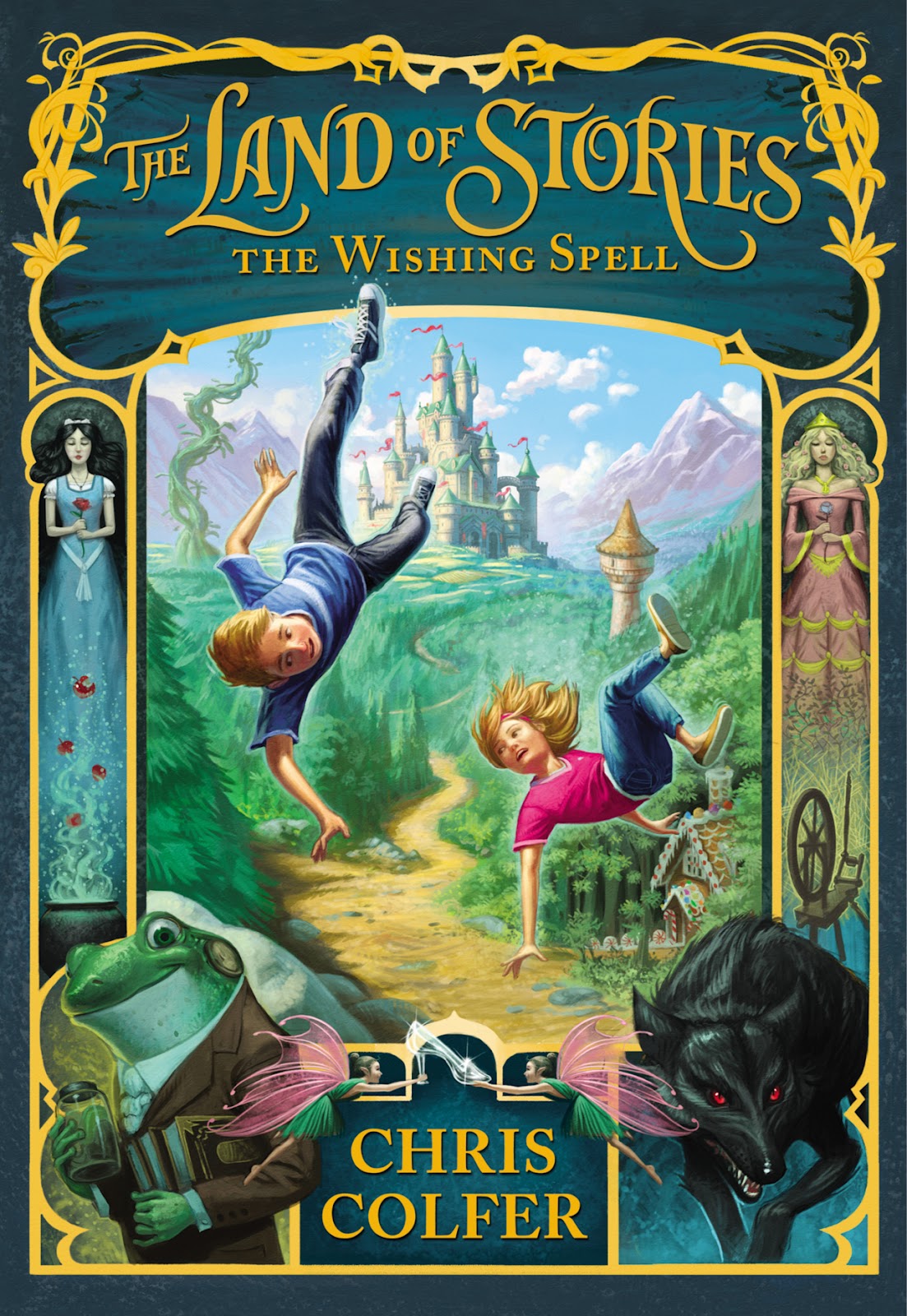
Reading challenge book 12: The Land of Stories - The Wishing Spell by Chris Colfer

Book 12 in my challenge to read one book (I haven't read before) a fortnight in 2012 is The Land of Stories - The Wishing Spell by Chris Colfer.

Yes, this book is written by the same Chris Colfer who plays Kurt in Glee. That's the reason I bought it, but the reason I kept reading it was because it's actually quite good.

The Land of Stories - The Wishing Spell follows twins Conner and Alex Bailey as they fall into a fairytale book and find themselves in the land of fairytales, where all their favourite, and not so favourite, characters are actually real. To get back to their world, they must gather all the elements to make the wishing spell, which will grant them anything they wish.

Alex and Conner are likeable characters - Alex is a goody two shoes who is completely endearing because she genuinely cares, and Conner is a typical almost-teenage boy, getting into trouble but with a heart of gold under it all. 

It's the fairytale characters, though, who held my attention. Colfer's take on popular characters such as Red Riding Hood and Goldilocks was interesting, and gave well known and loved, or hated, characters a new edge. I particularly liked that some characters had unexpected personality traits, and that those I thought would have likeable alternative stories actually turned out to be a bit annoying, and vice versa.

Colfer has said in interviews he came up with the idea for The Land of Stories when he was eight, and it shows. There's clearly a child's imagination at work here, and since children's imaginations offer more freedom than an adult's, that means the world in the book is wonderfully created, and took me back to my childhood, where anything was possible.

Much as I loved the story, I do feel the writing could have been better. Colfer wrote The Land of Stories in between other projects (including filming Glee, going on tour, and writing and filming his first feature-length film) and I think it shows a little. Some of the story feels a little rushed, while other bits feel a little basic and undeveloped.

There's also the way that chapters don't always seem to flow. Rather, The Land of Stories reads more like a screenplay at times, which would make sense since Colfer spends his day reading television scripts and previously wrote a screenplay. Both of those require a little less detail than a book, as there comes a point when it's the director and actors' responsibility to fill in the gaps. However, a book does require a little more, and sometimes the space in between chapters seemed to have something missing.

In addition, Alex and Conner often fall into and out of trouble too easily. They spend a chapter fighting a baddie, and then suddenly in the next chapter they're walking down a path in a forest having escaped. The book is clearly episodic, and I would have liked some more narrative flow.

Still, Colfer does have a way with words, and weaves some beautiful lines. Among my favourite is one right at the beginning:
But what the world fails to realise is that a villain is just a victim whose story hasn't been told.
Colfer is clearly a very talented writer, and as he is writing a sequel to this book, I hope his editor is a little stricter with him, so the second book reads more like a book than a play.

One thing that deserves a mention is the illustrations in the book, done by Brandon Dorman. They're stunning, and I only wish the British version of the book included the map of The Land of Stories that is apparently in the American print.

The Land of Stories is a children's book in one sense - it's about fairytales, its protagonists are children, it's a story of good versus bad (or not). But Colfer's fan base, largely teenage girls and older women, means that there are probably more older people reading this book than children. And the thing is, this book really works for that audience. As said earlier, The Land of Stories takes me back to childhood, taps into the parts of my imagination I let gather dust as I grew up. That's the sign of a good book, one that takes you out of your world and into someone else's. I definitely found myself in Alex and Conner's world, and it's not a bad place to be.

Saturday, 11 August 2012

Reading challenge book 11: Forever by Maggie Stiefvater

Book 11 in my challenge to read one book (I haven't read before) a fortnight in 2012 is Forever by Maggie Stiefvater, the third book in a trilogy.

I'm a fast reader, but it took me ages to get through Forever. I started it months ago, read a large chunk and then put it down for a while as I got distracted by other things. Once I came back to it, I was reading just a few chapters at a time and then coming back to it a few days later.

Ordinarily, the only reason it would take me so long to read a book was if I didn't like it. That's not the case with Forever. It's just the kind of book you can take your time with, and there's so much going on that you need that time to absorb all the feelings conjured up by the characters.

The two previous books in the trilogy, Shiver and Linger, introduced us to Sam, a boy who turned into a wolf during winter months, and Grace, the girl who loved him. During the course of the first two books, Sam was cured, but Grace, bitten as a child, finally succumbed to the wolf venom stuff inside her, and at the end of the second book became a wolf for winter.

In Forever the pair are left wondering if they can ever be together as humans. Their struggle though, is against the backdrop of a larger problem - there is a campaign to kill all the wolves in Mercy Falls after one wolf bit and killed Jack Culpepper way back in book one.

It's that storyline that adds an edge of danger to the book, and that makes all the relationships in Forever that much more serious and filled with emotion. And lifts it above something like Twilight, where danger is in the background but never really materialises.

Sam and Grace are compelling as always. Even though they're so young, Stiefvater gives them both a maturity that makes their love for each other completely believable.

But without strong supporting characters, Forever, and the other books in the trilogy, would be much less fascinating. For me, Isabel Culpepper (Jack's sister) and Cole St Clair (a former rock star who chose becoming a wolf over killing himself) are the second heart of the book after Sam and Grace.

Isabel and Cole's relationship is complicated, and the pair don't easily fall together, which makes them absolutely compelling to read about. They are flawed, selfish human beings, but that's what makes them so realistic. I only wish Stiefvater had paid more attention to them in the book, although being able to fill in the gaps for myself is partially what made them such great characters for me.

Forever isn't a happy book. It's sad and angry and devoid of hope by turns, and it's a read that clearly makes you feel the emotions of its characters.

Even though there's no doubt as to what happens in terms of the hunting of the wolves, there are a couple of very important things left unresolved. This is no bad thing - Stiefvater signposts the direction things may go in, but ultimately leaves it up to the reader to decide exactly what comes next. Stiefvater treats her readers with respect, understanding that we are clever enough to come to our own conclusions, and that's what I loved so much about this trilogy.

Reporting tips: Proofreading

This is by far the riskiest blog post I've written, since it's about proofreading and I'm bound to make a mistake that I won't spot on my subsequent read throughs. Still, let's treat it as a proofreading test for everyone. 

Proofreading is a key skill for journalists, since it's really annoying for news editors and subs to get work littered with easy mistakes that would have been spotted had the copy been read through by the reporter before it was filed. Here are a few tips to help you spot most of those pesky mistakes:

Reread
This might seem obvious, but reread copy after you've finished it. I have seen so many pieces of copy where a reporter has clearly not even glanced at their work after completion, as if they had they would have noticed the typo in the first line.

Give yourself some time
Often it's difficult to spot a mistake straight after you've written something, so work on something else for five minutes and then go back and reread your work. That little bit of time will often give you the fresh pair of eyes you need to spot any errors.

Read out loud
This does help, because then you're actually taking in what you're reading, and you'll stumble over anything that's wrong.

Read backwards
You don't have to read the letters backwards (!), but start at the end of your piece and look at each word on its own. This sounds strange, but it'll really help you see if you've got the spellings of words right, and if you've used the correct type of word (there/their/they're). It helps because you're reading the word that's actually there, and not what you think you've written based on what comes before and after.

Print it out
A little bit environmentally unfriendly, so don't do this for every piece. Printing something out and reading it in hard copy will make mistakes easier to spot than looking at it on the screen you've been staring at for the past few hours.

Read in a different programme
If you can't print your work out, read it in a different programme to the one you've written it in. So if it's in a content management system you use, copy and paste it into a word document. Again, the different format will make you see it differently and you'll be more likely to spot errors.

Read the contractions
If you've used contractions, read them out as what they would have been if you'd used both words, just to check you've used the right forms. So where you've written "you've" read it as "you have" when proofreading.

And that's it. Mistakes will happen (until humans are perfect mistakes will always happen), but following the steps above means you'll make fewer errors. As an exercise, use the steps above and point out the mistakes I've made in this blog!

Sunday, 8 July 2012

You should watch... Twenty Twelve

Sick of the Olympics already? Trust me, watch Twenty Twelve and you'll fall in love with them all over again, even if it is for all the wrong reasons.

For those of you haven't seen it, Twenty Twelve is a satirical comedy looking at the London 2012 Games. It follows the group of people in charge of putting the Games together, who are mostly inept, always messing the simplest of things up in spectacular fashion, and really, really funny.

The cast is led by Hugh Bonneville, who plays Ian Fletcher, head of Olympic deliverance. Despite having a crazy ex-wife who always used to give him grief and has now just chucked him out, he would be able to get most things done, if only it wasn't for his team.

They include Graham Hitchens (played by Karl Theobald), whose attempt to come up with the Olympic Torch relay route looked like a two-year-old child had scribbled on a map of Britain; Kay Hope (Amelia Bullmore), the head of sustainability who spends more time annoyed at people mixing sustainability up with legacy to do any work; and Nick Jellett (Vincent Franklin), who plays a stereotypical dour northerner.

My personal favourite character is Siobhan Sharpe, played by Jessica Hynes. Siobhan is PR for the Olympic deliverance team, knows nothing, and spends a lot of time saying "yah" and "tell me about it". I love her. 

Siobhan's highlights include thinking Muslims are not people who follow Islam, but rather people who follow the religion of Muslimian, and, with her PR team, coming up with the slogan Jubilympics to describe the summer's two biggest celebrations. She is a genius.

The great thing about Twenty Twelve is that it takes real life Olympic news and then gives them a comic twist. So the episode about protests against having equestrian events in Greenwich Park was based on the views of real protestors, only the real protestors didn't leave a giant pile of steaming horse dung outside the offices of the London 2012 organisers. 

Twenty Twelve ran for a very short first series in 2010, and an even shorter second series earlier this year (I recommend you search YouTube for clips), but thankfully it's back ahead of the opening of the Olympic Games. The first episode back, called Catatrophisation, includes a focus on what will be done with the Olympic Stadium after the Games, a real-life problem facing Games' organisers; shows Graham getting into his usual scrapes; and has Siobhan and her team trying to come up with a sexy name for the Travel Advice Pack. Oh, and someone has been caught converting Olympic starting pistols to fire live rounds.

The Olympic Games may be coming round too fast for some people, but Twenty Twelve can't start soon enough for me. 

Twenty Twelve is on BBC2 on Tuesday, July 10 at 10pm.

Saturday, 7 July 2012

Film review: The Five-Year Engagement starring Emily Blunt and Jason Segel

Here's what I was expecting when I went to see The Five-Year Engagement - a romantic comedy with a teensy bit of angst, maybe a little bit of swearing, and an easy-to-come-by happy ending.

Here's what I got when I went to see The Five-Year Engagement - a romantic comedy that ripped my heart out before proceeding to piece it back together, a lot of awkwardness, some really rude moments and a happy ending that everyone had to work for.

And guess what? I really enjoyed the surprise.

I'm a big fan of Emily Blunt, but I never realised just how funny she could be as an actress. It would have been so easy for Blunt, as lead character Violet, to have been overshadowed by Jason Segel's Tom, but Blunt held her own, and in fact was part of the funniest scene in the film, which didn't feature Segel at all and involved Blunt arguing with her sister, with both of them doing the voices of characters from Sesame Street the whole time.

Violet and Tom have just got engaged (hilarious proposal) and are planning their wedding when Violet gets a job offer of her dreams. The couple agree Violet will take the job and schlep off to Michigan, where Tom finds himself getting increasingly more miserable without a fulfilling job, and Violet finds herself thriving on success.

Cut to a few years later and Tom has let himself go a bit, and is now living like some kind of caveman (hunting his own meat, massive amounts of facial hair).

The pair get their act together slightly and decide to go ahead and get married. Unbeknownst to Tom, the catalyst is because Violet has been kissed by her boss. Tom almost doesn't find out, but in a heartwrenching scene he runs away after discovering the truth, does something he really regrets, and wakes up naked in a forest the next morning and has to have his toe amputated.

Tom and Violet's drifting apart is filled with comic moments, but it's hard to watch them go through the tough times, and when Tom was wondering through the forest I found my laughter turning into (unshed) tears as the moment turned from comic to tragic.

As a side plot to Tom and Violet are Tom's best friend Alex and Violet's sister Suzie, who stumble their way into a relationship and somehow manage to make it work, despite being completely unsuited to each other and yelling at each other most of the time they're on screen together. The other two romantic relationships on screen - Violet's dad and stepmum, and Tom's parents - are also far from smooth yet both couples make it work, and all three relationships act as a contrast, and something to aspire to in some ways, for Tom and Violet.

The relationships in The Five-Year Engagement aren't pretty ones - there are no slow motion kisses in the rain, no well-timed coincidental meetings. Instead, The Five-Year Engagement is a romantic comedy with a slightly realistic edge. It's still a film so it can't mirror real life completely, but I enjoyed the move-like happy ending even more because of the reality that preceeded it.

ShareThis

Related Posts Plugin for WordPress, Blogger...